
Battery connectors
AM and ECS connectors — 20 A bullet contacts, 40 A on the ECS body
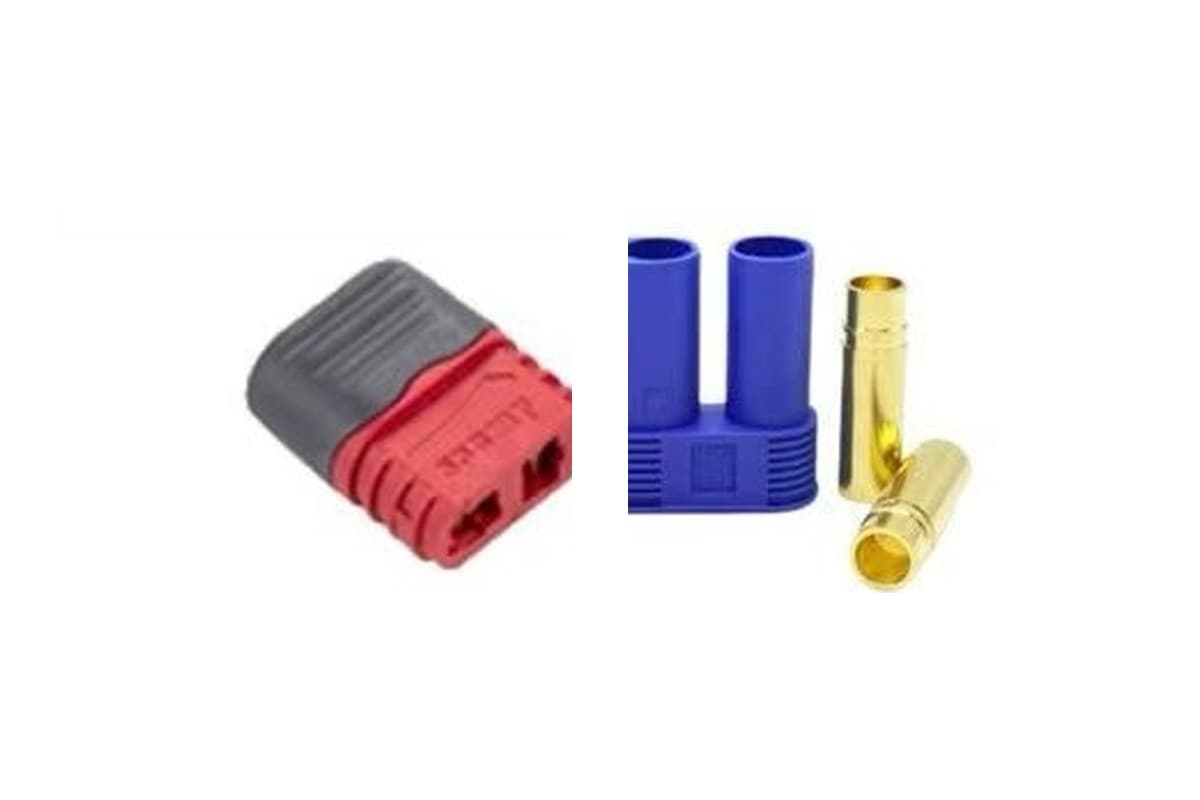
AM and ECS are the red/black and gold-look blue versions of the same bullet idea: a spring-loaded split contact that holds current through vibration without a latch. AM-1015 runs 20 A on 16 AWG in four variants, ECS-F and ECS-M run 40 A in a gold-plated blue housing. Both are solder-terminated with a 180° wire exit, and both come out of our Shenzhen plant.
- AM-1015: 20 A max, 16 AWG, 85 °C
- ECS: 40 A max, gold-plated blue housing
- 180° wire exit, solder termination
- Male and female supplied as a pair
- Produced in our Shenzhen plant
Specification
Series figures from the catalogue
The catalogue states current, wire size and temperature for each series. Contact resistance, mating cycles and flammability class are not printed there, so they stay open until the factory datasheet is confirmed.
| AM-1015 series | 20 A max, 16 AWG, 85 °C |
|---|---|
| AM variants | AM-1015E-F / AM-1015E-M / AM-1015-F / AM-1015-M |
| ECS series | 40 A max, gold-plated blue housing, 85 °C |
| ECS variants | ECS-F and ECS-M |
| Termination | 180° wire exit, solder |
Where AM and ECS sit in the range
Below the XT series in current, above the small signal connectors: AM-1015 at 20 A covers the balance lead and the accessory circuit, ECS at 40 A covers the main pack lead on smaller packs where an XT90 body is too big for the housing.
Because all three families share the bullet principle, a product can use AM for a low-current tap and XT90 for the main lead without two different termination processes on the line.
Why the ECS body is gold-plated blue
The plating is a corrosion decision, not a cosmetic one: gold on the contact keeps the interface stable where the pack is stored for long periods, and the blue housing makes the higher-current part visually distinct from the 20 A AM at the assembly station.
If your buyer needs the parts to be visually different per circuit, that colour coding is worth putting in the drawing.
Mating with the pack harness
Bullet contacts rely on the spring inside the female half. Two things decide whether the pair survives: the wire gauge the contact was sized for, and whether the harness is strain-relieved behind the connector. A 40 A contact on an undersized wire will run hot at the contact even though the connector is rated for it.
Send the wire gauge and the expected continuous current, not just the peak, and we will confirm the family rather than the other way round.
What to send for a quotation
Family (AM or ECS), male or female or the pair, wire gauge, expected continuous current and the annual volume. If the pack already has an XT body on the drawing, say so — it may be cheaper to stay in the XT family than to add a second tooling set.
FAQ
Questions buyers ask before ordering
- What is the difference between AM and ECS?
- Current and body: AM-1015 is 20 A on 16 AWG, ECS is 40 A in a gold-plated blue housing. Both are 180° wire-exit solder parts with the same bullet contact principle.
- Are AM-1015E and AM-1015 different?
- They are separate variants in the same series, each supplied male and female. Send the drawing or the model you already use and we will confirm which one matches.
- Can AM and ECS mate with XT connectors?
- No. They are different bodies and different contact sizes. Keeping one family per circuit is the safer design rule.
- Do you have the full datasheet?
- The catalogue gives current, wire size and temperature. Contact resistance, mating cycles and flammability class are made to your specification - tell us the values you need to meet and the part is built and quoted against them.
- Samples come from the plant that will run production
- Non-standard tab spacing or barrel size is a tooling question, quoted separately
- We will not promise a sample date before the drawing is reviewed
Send the drawing or the part number
We quote against your specification rather than a catalogue number. Include the application, the annual volume and any test report the buyer requires.