
Power input
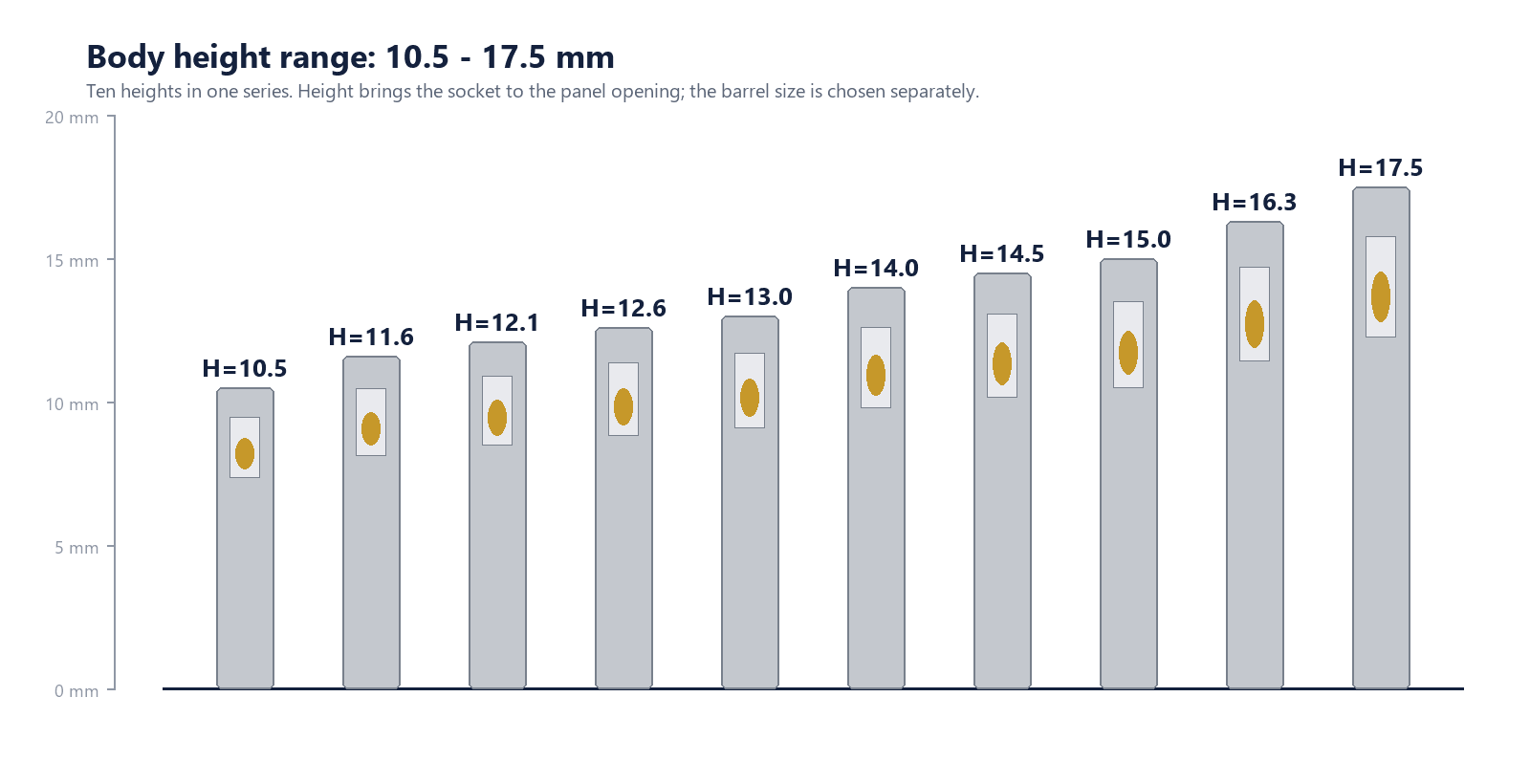
Vertical DC power jacks — ten body heights from 10.5 to 17.5 mm
A vertical DC jack stands on the board and takes the plug from above, which is what a top-panel socket or a recessed enclosure needs. This series covers ten body heights from 10.5 mm to 17.5 mm, so the socket can be brought to the panel without a separate extension, and the factory marks the parts as a high-current input.
- Ten body heights: 10.5, 11.6, 12.1, 12.6, 13.0, 14.0, 14.5, 15.0, 16.3, 17.5 mm
- Vertical orientation, plug enters from above
- High-current input family (20 A marking on the factory parts)
- Board-mount, multiple part numbers per height
- Produced in our Shenzhen plant
Specification
Height range and open items
Height is the parameter that selects the part, and it is fixed across the series. Current rating, plating and temperature are quoted per part number.
| Body heights (mm) | 10.5 / 11.6 / 12.1 / 12.6 / 13.0 / 14.0 / 14.5 / 15.0 / 16.3 / 17.5 |
|---|---|
| Orientation | Vertical |
| Rated current | 20 A |
| Mounting | Through-hole |
Height is the parameter that picks the part
On a vertical jack the body height is what puts the socket at the right depth behind the panel. Too short and the plug does not reach; too long and the board cannot sit where the enclosure wants it. The ten heights in this series are the selection range, and the part number follows from the height plus the barrel size.
Measure from the board surface to the panel opening, then allow for the panel thickness and the plug's own shoulder. That number is what you quote to us.
What the 20 A marking means, and what it does not
The factory marks these parts as a high-current input and prints 20 A against the family. That is the family rating, and it is not a guarantee for every part number in it: the barrel size, the contact design and the board copper all change what the part can carry in a real assembly.
Treat 20 A as the ceiling for the series, confirm it against the specific part you order, and check the temperature rise in your own enclosure before designing to the top of the range.
Where a vertical jack is the right answer
Top-panel sockets on instruments, chargers and industrial boxes; enclosures where the board sits parallel to the panel opening; and any design where a horizontal jack would need a right-angle extension or a separate harness.
The trade-off is height above the board: a vertical jack occupies the space a horizontal one leaves free, so confirm the internal clearance before layout.
What to send for a quotation
Required height, barrel size, the current you need to carry, mounting, and whether a switching contact is needed. Send the panel opening drawing if it exists — it settles the height question in one step.
FAQ
Questions buyers ask before ordering
- Which heights are available?
- Ten: 10.5, 11.6, 12.1, 12.6, 13.0, 14.0, 14.5, 15.0, 16.3 and 17.5 mm. The height plus the barrel size determines the part number.
- Is 20 A the rating of every part?
- No. 20 A is the family marking on the factory parts; the actual figure depends on the barrel size, contact design and your board copper. Confirm it for the part number you order.
- Can the jack reach the panel without an extension?
- That is what the height range is for. Measure board surface to panel opening, allow for panel thickness, and pick the height that closes the gap.
- Do you supply the matching plug?
- The jack is supplied on its own; the plug usually comes with the adapter. Send the adapter's plug drawing so the barrel size matches.
- Samples come from the plant that will run production
- Non-standard tab spacing or barrel size is a tooling question, quoted separately
- We will not promise a sample date before the drawing is reviewed
Send the drawing or the part number
We quote against your specification rather than a catalogue number. Include the application, the annual volume and any test report the buyer requires.