
RC and drone connectors
MR and MT connectors — 30 and 60 size, 20 A and 35 A
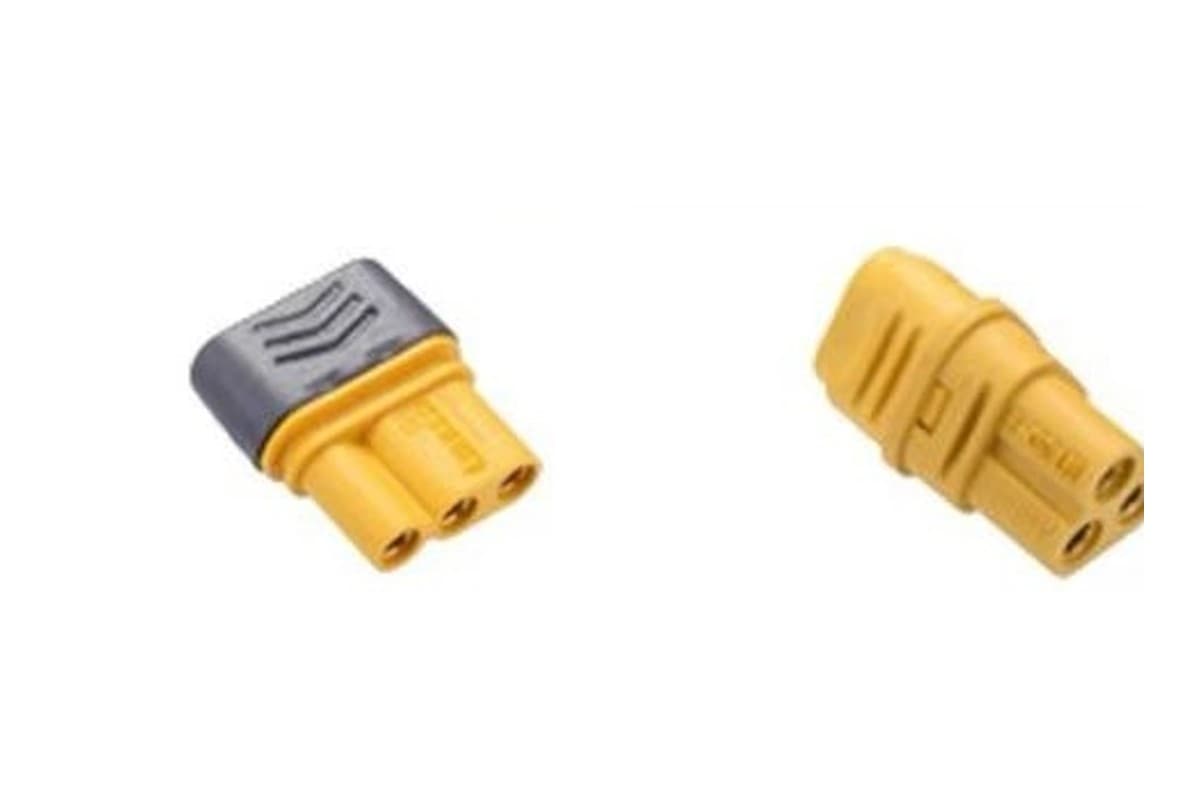
MR and MT are the compact bullet connectors used where an XT body is too wide: MR30 and MT30 at 20 A on 16 AWG for the smaller packs, MR60 and MT60 at 35 A on 12 AWG for the main lead on a drone or car pack. Both come male and female, with a 180° wire exit and solder termination, from our Shenzhen plant.
- MR30 / MT30: 20 A max, 16 AWG, 85 °C
- MR60 / MT60: 35 A max, 12 AWG, 85 °C
- 180° wire exit, solder termination
- Compact body for tight airframes
- Produced in our Shenzhen plant
Specification
Series figures from the catalogue
Current, wire size and temperature are stated per series. Everything else — contact resistance, mating cycles, housing material — is set by your drawing, because these are made-to-order parts rather than catalogue stock.
| MR30 / MT30 | 20 A max, 16 AWG, 85 °C |
|---|---|
| MR60 / MT60 | 35 A max, 12 AWG, 85 °C |
| Variants | MR30-F / MR30-M, MR60-F / MR60-M, MT30-F / MT30-M, MT60-F / MT60-M |
| Termination | 180° wire exit, solder |
MR and MT: same rating, different body
The 30 size carries 20 A on 16 AWG and the 60 size 35 A on 12 AWG in both families. The difference is the housing and the way the pair seats: MR is the round bullet body, MT the compact variant with a different shoulder, chosen by what fits the airframe or the car chassis rather than by current.
That means the selection is mechanical first: measure the space the pair has to occupy, then pick the family that fits, then confirm 20 A or 35 A against your continuous current.
Why drones and RC cars use this size
An XT60 pair is wider than the space between the plates on many small airframes, and a solder joint on 12 AWG needs room behind the connector. MR60 and MT60 put 35 A into a narrower envelope, which is why they appear on 4S–6S packs and on the ESC side of a car.
The trade-off is handling: a smaller body has less surface to grip and to strain-relieve, so the harness needs support behind the connector.
Soldering 12 AWG without cooking the housing
A 12 AWG joint needs heat, and the housing is closer to the cup on a compact body than on an XT90. Tin the wire first, keep the iron on the cup for the shortest time that wets it, and let the part cool before mating it — a distorted housing will not seat reliably afterwards.
If your line cannot control that, ask for the pre-assembled lead option instead of buying loose connectors.
What to send for a quotation
Size (30 or 60), family (MR or MT), male/female/pair, wire gauge, continuous current and the annual volume. If the airframe drawing exists, send it — the fit question is answered faster from the drawing than from a description.
FAQ
Questions buyers ask before ordering
- What is the difference between MR and MT?
- The housing and the way the pair seats. Both carry the same current at the same size — 20 A at size 30 on 16 AWG, 35 A at size 60 on 12 AWG.
- Can MR60 replace an XT60?
- Electrically at 35 A, yes. Mechanically no — the bodies and the footprint differ, so it is a design change, not a drop-in swap.
- Do you supply male and female separately?
- Yes. Each model exists as -F and -M, and they are normally ordered as a pair.
- Is the housing material specified?
- Made to your order, so the material follows your drawing. Tell us the class your certification needs and we will confirm the material we will run against it.
- Samples come from the plant that will run production
- Non-standard tab spacing or barrel size is a tooling question, quoted separately
- We will not promise a sample date before the drawing is reviewed
Send the drawing or the part number
We quote against your specification rather than a catalogue number. Include the application, the annual volume and any test report the buyer requires.