
Battery contacts
Spring battery connectors — 1 to 6 positions, gold-plated contacts
A spring battery connector holds a battery terminal against a board without a wire: the contact is a spring, so it absorbs tolerance and keeps pressure through the life of the product. These are made in our own Shenzhen plant in 1 to 6 positions, with gold-plated contacts, in SMD or DIP mounting, and a white vertical housing where the assembly needs to pick the connector from above.
- 1 to 6 positions, single or multi-cell battery contacts
- Gold-plated contact tips
- SMD and DIP mounting
- White vertical housing option
- Produced in our Shenzhen plant
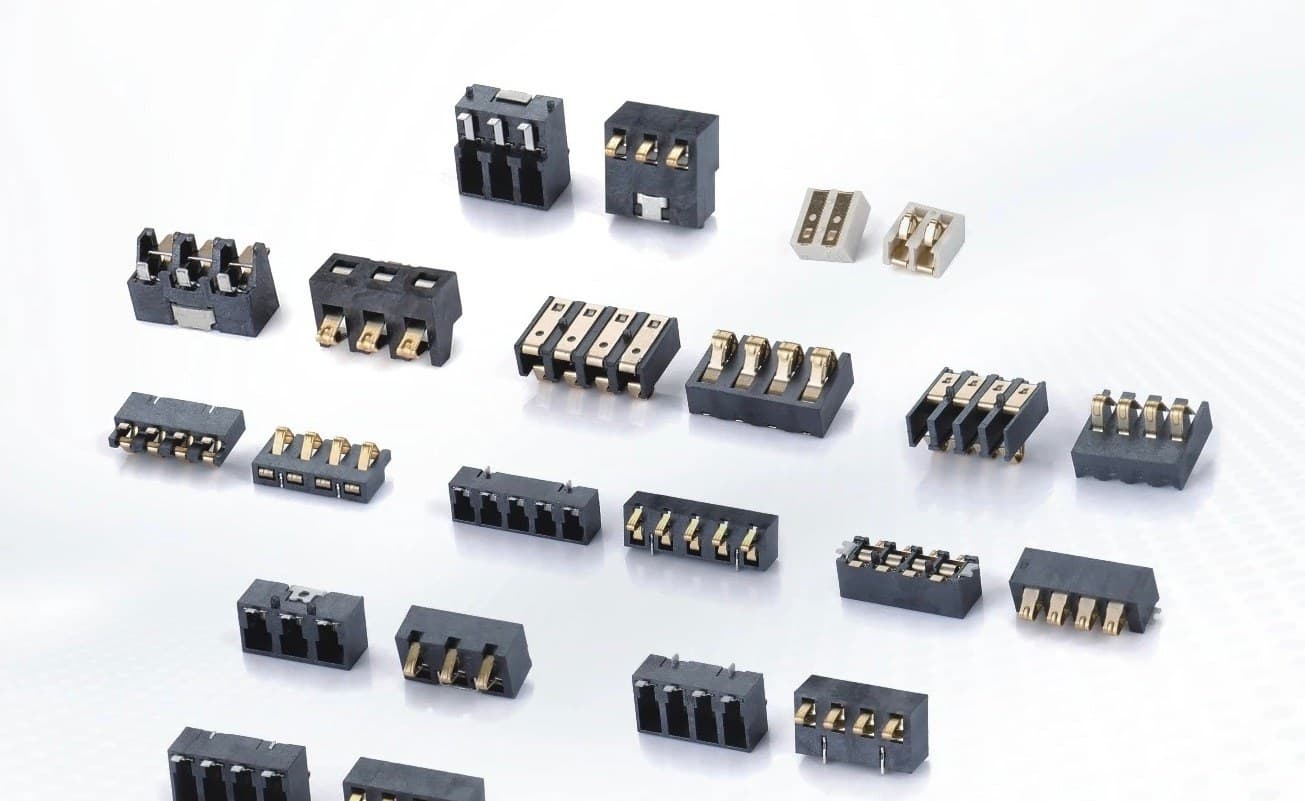
Specification
What is fixed, and what the factory has to confirm
Only the parameters stated in the factory material are listed as fixed. Everything else is left open rather than estimated — ask for the datasheet for the variant you are considering.
| Position count | 1–6 |
|---|---|
| Contact plating | Gold-plated |
| Mounting | SMD or DIP |
| Housing variant | White vertical housing available |
Choosing the position count
The position count follows the battery arrangement on the board: one contact per terminal, plus any sensing or spare contact the design wants. Because the same housing family covers 1 to 6 positions, the mechanical footprint changes only in one direction, which keeps a board revision cheap when a product moves from one cell to two.
Confirm the position count together with the mounting type before tooling: an SMD layout and a DIP layout are not interchangeable, and the vertical housing needs clearance above the board that a low-profile design does not.
Why the contact is plated
The spring does two jobs: it carries current and it maintains pressure. Gold plating on the contact tip keeps the interface stable when the battery is inserted and removed repeatedly, and it stops the film that forms on bare metal in humid storage.
If your application cycles the battery often, ask for the plating thickness and the contact resistance on the datasheet rather than assuming a figure — the material we hold states plating type only.
Where these are usually specified
Handheld instruments, portable measurement tools, small appliances and any product where the battery sits in a compartment and the board sits underneath it. The connector is chosen at layout stage, so purchasing usually confirms position count and mounting with the design team before asking for a price.
For a product that ships with the battery installed, also settle the retention force with the factory: the spring has to hold the cell during transport without making it hard for the end user to remove.
What to send for a quotation
Position count, mounting type, housing orientation, the board thickness and the annual volume. If the design is not fixed yet, send the battery type and the space available and we will say which of the standard variants fits.
Samples come from the same plant that will run production, so what you approve is what ships.
FAQ
Questions buyers ask before ordering
- What position counts are available?
- 1 to 6 positions in the standard range. The count follows the number of battery terminals plus any sensing contact the design needs.
- Is it SMD or through-hole?
- Both are available. SMD suits automated reflow assembly; DIP suits through-hole soldering. They are different footprints, so choose before the board is released.
- Is there a vertical version?
- Yes — a white vertical housing is available where the assembly needs to place the connector from above. Confirm the clearance above the board before layout.
- Can you confirm rated current and temperature?
- Those are built to order. Send the position count, the mounting and the rating you need, and the part is made to that drawing - we quote the figures we will hold, not a series average.
- Samples come from the plant that will run production
- Non-standard tab spacing or barrel size is a tooling question, quoted separately
- We will not promise a sample date before the drawing is reviewed
Send the drawing or the part number
We quote against your specification rather than a catalogue number. Include the application, the annual volume and any test report the buyer requires.